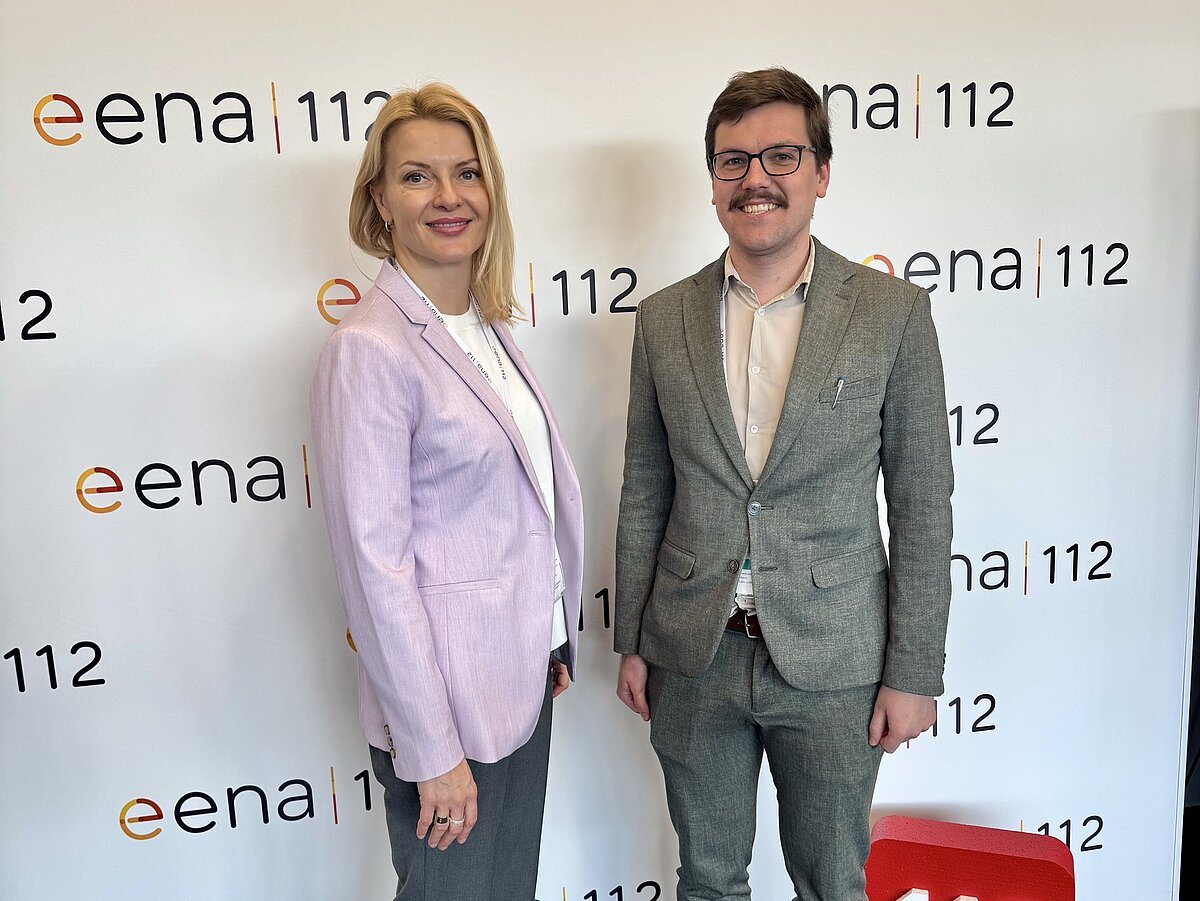
Researchers from the Faculty of Economics and Social Sciences (FESS) at the University of Latvia (UL), Ieva Birka and Roberts Kits, used this opportunity to gain in-depth insights into the latest developments in public warning systems and civic engagement.
“The conference provided valuable insight into how public warning systems are being developed across different European countries and how technologies can contribute to building a more active and informed society. Particularly important are solutions that enable reaching the widest possible audience,” emphasises Ieva Birka, who leads a research project at the UL on strengthening resilience in the Baltic region.
One of the central themes of the conference was the development of public warning systems. Multiple sessions addressed best practices in disseminating alerts, national strategies for using diverse communication channels, and the latest technological innovations — including satellite systems and cell broadcast technologies. Particular attention was given to solutions ensuring information accessibility for broader audiences, including persons with disabilities.
Extensive discussions also focused on the implementation of artificial intelligence (AI) in emergency management. The use of AI in call handling, dispatching, and reducing response times was analysed, highlighting its potential to improve the efficiency of emergency services.
In the exhibition area, dozens of technology companies from across Europe showcased solutions for emergency communication, public warning, and safety. The researchers had the opportunity to engage directly with company representatives, explore specific products, and gain an overview of technologies already in use as well as those that may become available in Latvia and the wider Baltic region in the coming years.
“In our future research, we will analyse how to promote citizens’ practical engagement in reporting suspicious activities and how this goal can be most effectively achieved using modern technologies. The insights gained at the conference — both on public warning systems, AI tools, and community preparedness — provide a valuable comparative perspective and help us better understand which solutions are already successfully functioning elsewhere in Europe,” notes Ieva Birka.
The fundamental and applied research project “Strengthening Baltic Resilience: From Technology to Awareness and Action” (No. lzp-2025/1-0191), supported by the Latvian Council of Science, is being implemented by a research team at UL FSS, under the leadership of Leading Researcher Ieva Birka. The project began in January 2026 and is planned to run for three years.