
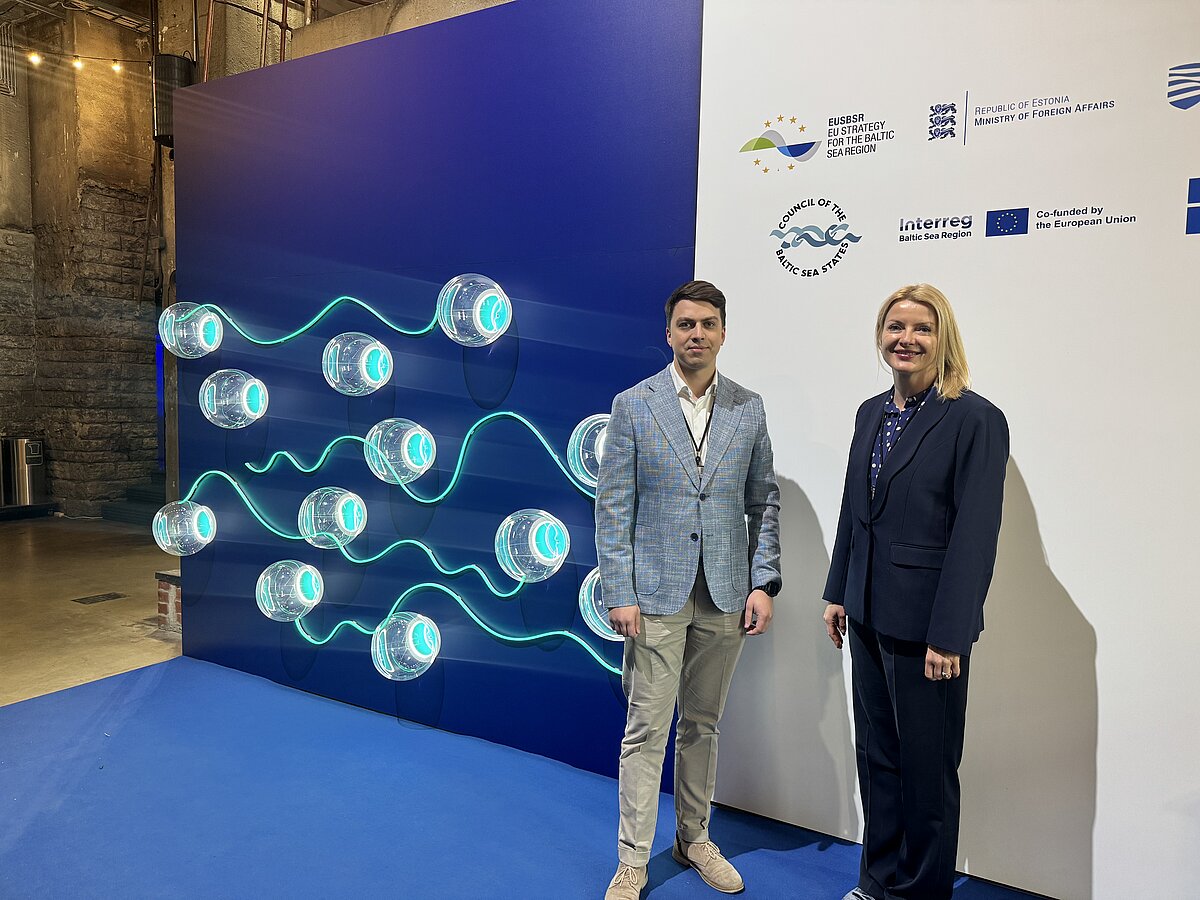
From 11–13 May 2026 in Tallinn, the annual EUSBSR forum brought together more than 500 representatives from Baltic Sea Region countries — including policymakers, implementers of EU projects, and researchers. At the forum, the FESS team — lead researcher Ieva Birka and expert and PhD candidate Armands Astukevičs — presented the University of Latvia’s High Impact Development Programme project “Baltic Individual Crisis Preparedness Barometer” at an information stand. They showcased survey data collected in 2025 and outlined the planned research activities for 2026–2028.
The project received international attention. On the first day of the forum, Inese Vaivare, Director of the Latvian Platform for Development Cooperation, referenced the project data in her keynote speech “Securing the Baltic Sea Region: The Role of Cities and Regions in Times of Geopolitical Uncertainty,” highlighting its relevance in the context of regional security. During the plenary session “Security and Geopolitical Uncertainty” on 12 May, the Secretary General of the Council of the Baltic Sea States (CBSS), Gustav Lindström, cited the project’s findings in a discussion on geopolitical uncertainty in the region and the need to strengthen citizen preparedness and awareness.
“References to our research and the citation of its data at the EUSBSR forum send a clear message: comparative, regionally grounded data on individual and household crisis preparedness are not only academically valuable but also highly relevant for policymakers,” emphasizes lead researcher Ieva Birka after the forum. “At the highest levels of regional security planning, there is genuine interest in such an evidence base. We are proud that at the University of Latvia we are helping to fill this evidence gap by building a dataset that communicates across borders and provides Baltic Sea Region decision-makers with a shared, reliable assessment of societal resilience.”
At the forum, FESS researchers established several promising international contacts. In discussions with a representative of the Icelandic Civil Protection and Emergency Management Agency, Hjördís Guðmundsdóttir, potential avenues for further project development and Iceland’s possible participation in the study were explored. The applicability of the project’s data within the Interreg project “PrepAlliance – Allies Increasing Preparedness Level Among Citizens” was also considered. A meeting with Monika Kantak, National Representative of the International Organization for Migration (IOM) in Poland, explored potential cooperation using forthcoming Warsaw data within joint events and research initiatives.
The research project “Baltic Individual Crisis Preparedness Barometer” (No. ZDA-LIP2025/16) is a University of Latvia High Impact Development Programme project implemented from 2026 to 2029. The High Impact Development Programme at the University of Latvia was established to bring together interdisciplinary research teams, combine scientific expertise, and jointly address pressing challenges for Latvia and the world.
 at the University of Latvia (UL) presented the implementation and findings of a high-impact project on citizen crisis preparedness at the annual forum of the EU Strategy for the Baltic Sea Region (EUSBSR), highlighting the urgent need to improve public preparedness levels and awareness.)