
Why can a social issue remain at the center of media and political attention for years, only to gradually lose its place on the agenda? And what happens to public attitudes when the established framing of a topic changes? One sociological concept used to explain such processes is moral panic – a situation in which a specific social group or phenomenon is perceived and publicly represented as a threat.
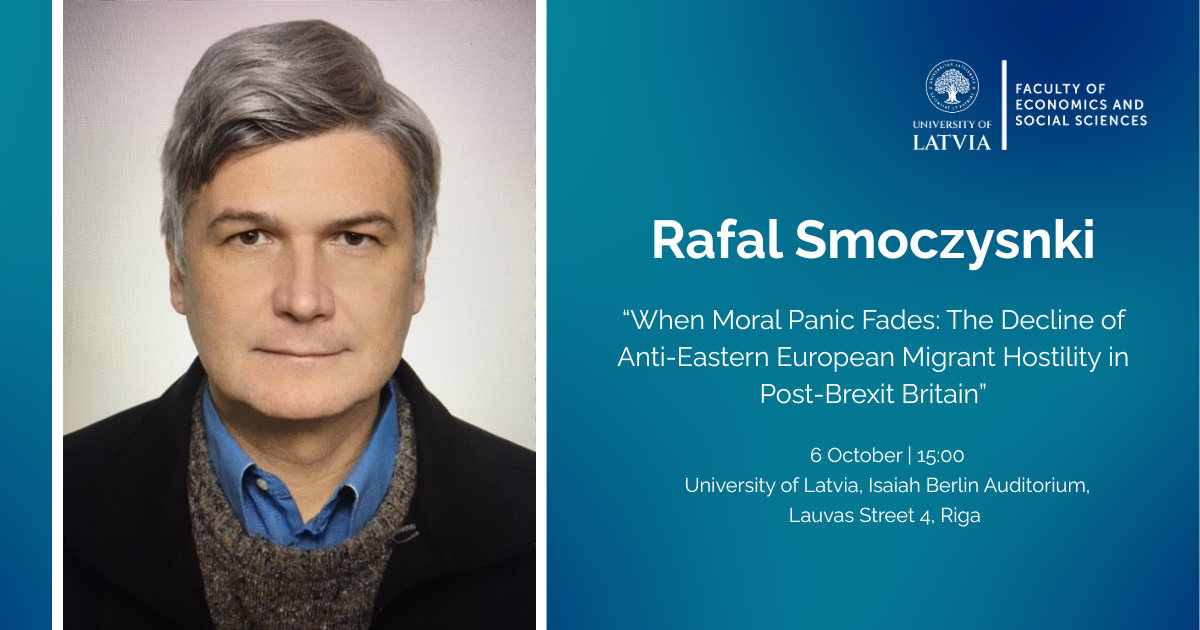
“One example is the moral panic surrounding Easter European migrants in Britain. For a long time, these migrants were portrayed as a threat to the employment and economic security of the native population, but following the Brexit referendum, this rhetoric gradually lost much of its previous intensity,” explains Rafal Smoczynski. In the guest lecture he will explain the reasons behind this shift and what role mainstream media and political actors played in the process. The sociologist will present findings from qualitative interviews conducted with Eastern European migrants in northern England and analyze how migration was portrayed in the British media.
The results of the interviews and media analysis suggest that the shift in attitudes was not solely linked to the labor market situation or the fulfillment of economic promises related to Brexit. A significant factor was the reduced repetition and reinforcement of anti-migrant narratives by the media and politicians. As the media amplification weakened, so did the moral panic. While negative attitudes toward migrants did not disappear entirely, they no longer exerted such a broad influence on society, manifesting instead more frequently in interpersonal encounters and online interactions.
The guest lecture will provide insight into the pivotal role media and political communication play in shaping public attitudes – both in generating moral panic and in contributing to its decline over time.
Rafal Smoczynski is a sociologist, an Associate Professor at the Institute of Philosophy and Sociology of the Polish Academy of Sciences, and Head of the Department for the Study of Religion. His research interests include social control, political philosophy, sociology of elites, and sociology of religion. His work has been published in Ethnic and Racial Studies, East European Politics and Societies and Cultures, Current Sociology, Theory and Society, among others. He has participated in projects funded by the European Commission, the Research Council of Norway, German Academic Exchange Service, and the Polish National Science Centre, and has acted also as a visiting professor at universities in Australia, South Korea, Iran, Poland, Japan, and Great Britain.
The guest lecture will be held in English.
All interested are welcome to attend the. Prior registration is required.
